
Floyd County Court Records After Arrest
The arrest-to-court path in Floyd County usually starts with arrest or warrant service, a magistrate bail decision when required, and commitment to New River Valley Regional Jail if the person is not released. Once the case reaches the judicial side, the Floyd County Commonwealth's Attorney acts as the local prosecutor. Virginia uses Commonwealth's Attorneys, not district attorneys. That office reviews and pursues criminal charges, while the courts maintain the formal court records after a jail arrest.
The booking side and the court side should not be merged. For custody and booking detail, use Floyd County jail inmate records. For booking photos, use the Floyd County jail mugshots page. Court records after a Floyd County arrest are different because they show filed charges, hearings, dispositions, amendments, fines, costs, and case status. A jail charge can be amended, reduced, dismissed, nolle prosequi, or indicted in a different form as the court case moves.
Find Floyd County Court Records After Arrest
The main online channel is the Virginia General District Court Online Case Information System. Floyd County General District Court handles many misdemeanors, traffic and criminal matters, preliminary hearings, and early felony proceedings. Floyd County Circuit Court handles felony indictments, felony trials or pleas, appeals from lower courts, and final felony dispositions. Juvenile and domestic matters can be restricted and may not appear in the same way.
- Use the NRVRJ profile first to collect the person's name spelling, date of birth if shown, county field, commitment date, charge description, charge code, and any case number.
- Open the Virginia General District Court case-search system and select the Floyd court when that is the charging jurisdiction.
- Search by defendant name or exact case number. Common names may need more than one search.
- Open the case and review each charge, hearing, disposition, bond entry, and status field.
- If a felony has been certified or indicted, check Floyd County Circuit Court channels and the clerk's office.
The Virginia Judicial System is the statewide court source. For fines and costs, Virginia also provides a Circuit Court criminal and traffic fines search. For a formal statewide criminal history, the Virginia State Police criminal background process is separate from a free jail roster or court lookup and can involve forms, fees, identification, fingerprints, and eligibility rules.
Floyd County Court Search Fields
The court portal is built around court selection and case search, not around jail custody. Use the jail record to improve the court search, then use the court record to verify the formal charge status. The court portal may not show every record, and it may not show full birth-date detail for every case.
| Field Label | Type | Required | Notes |
|---|---|---|---|
| Court | Dropdown or court selection | Yes | Select Floyd General District Court or the relevant court. |
| Search Type | Tab or route | Yes | Name, case number, hearing date, or related search path. |
| Last Name / Business Name | Text | Conditional | Main defendant-name search field. |
| First Name | Text | Optional or conditional | Narrows a name search. |
| Case Number | Text | Conditional | Use exact case number when known. |
| Hearing Date | Date | Conditional | Used for hearing or docket searches. |
The Virginia General District Court search landing is the official starting point for many Floyd County court records after an arrest.
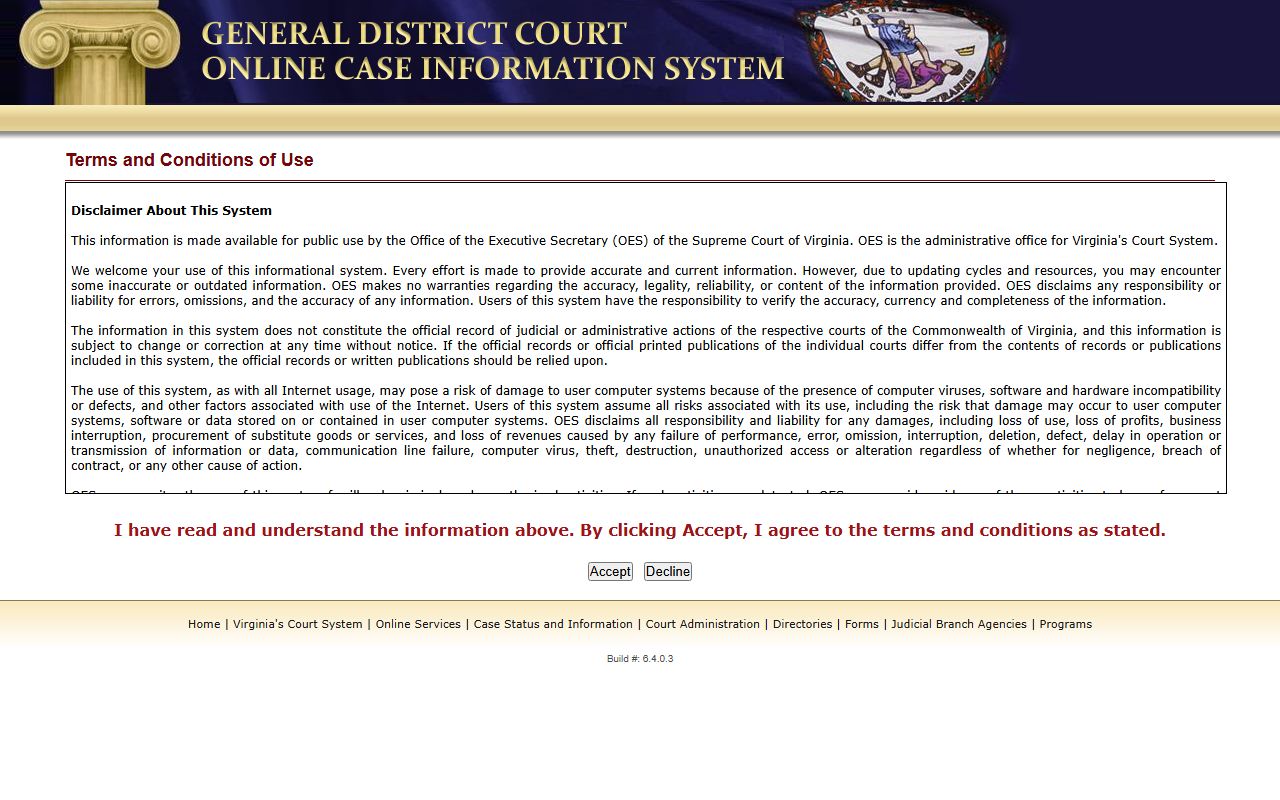
The case-search page should be used with the jail profile details because spelling, court selection, and case numbers can determine whether a result appears.
Charges Filed After Arrest
After a Floyd County jail arrest, the court record begins when a charging document creates or advances the case. The jail roster's charge row is a custody record. The court charge is the formal judicial record. Prosecutors can amend, reduce, dismiss, nolle prosequi, or indict charges, so the court record may not match the first jail booking text.
| Document | How It Fits the Case | Common Use |
|---|---|---|
| Complaint | Starts a criminal accusation in court or supports an initial charge. | Misdemeanors and early proceedings. |
| Information | A prosecutor-filed charge document used when permitted by procedure. | Some felony or negotiated matters. |
| Indictment | A grand jury accusation that moves a felony into circuit court. | Felony cases and serious charges. |
Floyd County Charge Status
Charge status terms matter because an arrest is not the same as a conviction. A case may remain pending for hearings, be reduced to a lesser charge, be dismissed, or end with a guilty finding. The court record is the better source for the current legal status, while the jail record is the better source for current custody and bond rows.
| Status | What It Means |
|---|---|
| Pending | The charge has not reached final disposition. |
| Amended or reduced | The formal charge changed as the case moved through court. |
| Dismissed | The charge ended without a conviction on that count. |
| Nolle prosequi | The prosecutor declined to proceed at that time. |
| Convicted or guilty | The case ended by plea, verdict, or adjudication on that charge. |
| Deferred disposition | The final outcome is delayed under court conditions. |
Bond After a Floyd Arrest
The NRVRJ inmate bonding page explains that a magistrate conducts a pretrial bail hearing after an arrest warrant and can set personal recognizance, unsecured bond, secured bond, or ineligible-for-bail status. Once the person is committed to jail, NRVRJ states that a judge is the only one who can lower bond or arrange recognizance bond. Jail staff cannot recommend a bonding agent.
| Bond Type | How It Works |
|---|---|
| Personal recognizance | A written promise to appear and obey terms, without a money pledge. |
| Unsecured bond | Release on a written agreement backed by possible forfeiture if the person fails to appear. |
| Secured bond | Release backed by cash, property, or a compensated or non-compensated surety. |
| No-bond or ineligible | Release is denied under the current order unless a judge changes it. |
Bond on one charge may not release a person when another hold exists. A detainer, probation or parole hold, federal or immigration hold, no-bond order, or second case can keep the person in custody after one bond issue is resolved. Compare the jail profile to the court record before assuming a payment will cause release.
Warrants and Capias Records
No official Floyd County Sheriff's Office active warrant search or NRVRJ warrant database was located in the official sources inspected. A warrant may appear indirectly after it leads to a booking, or it may appear in a court case when a capias or bench warrant is issued. NRVRJ's bond page notes that failure to appear or violation of release conditions can result in a capias or order to show cause.
- Arrest warrant: issued before arrest based on an alleged offense.
- Bench warrant or capias: issued by a court, often for failure to appear or violation of a court order.
- Search warrant: authorizes a search of a place or property, not a jail booking by itself.
- Fugitive warrant or hold: involves another jurisdiction seeking custody.
Because warrant status can change quickly and false positives are risky, direct court or sheriff confirmation is the safer path. Serious charges or a no-bond risk should be discussed with a licensed attorney before the person appears at an agency window.
Charges vs Convictions
Floyd County court records after a jail arrest can show accusations before they become final outcomes. A charge is a formal accusation. A conviction is a final guilty result by plea, verdict, or adjudication. Treating every jail charge as a conviction is inaccurate and can harm the person whose record is being reviewed.
| Charge | Conviction | |
|---|---|---|
| Stage | Accusation or filed count | Final guilty outcome on a count |
| Source | Jail profile and court case filing | Court disposition |
| Can change | Yes, it may be amended, reduced, or dismissed | Changes only through court process, appeal, or later relief |
Sealed and Expunged Records
Virginia expungement is governed by Va. Code Section 19.2-392.2. Expungement is not the same as a normal online search result disappearing. Eligibility depends on the case outcome and the statute. Juvenile matters, sealed records, ongoing investigations, and records withheld under a specific exemption may not be available through the public portal.
| Sealed | Expunged | |
|---|---|---|
| Public visibility | Hidden or restricted from ordinary public access. | Removed from ordinary public access under the expungement process. |
| Where to ask | The court or clerk that controls the record. | The court process under Virginia expungement law. |
| Floyd County effect | May limit what online portals show. | May affect court and related arrest record access if granted. |
Access Limits After Arrest
Virginia FOIA supports access to existing public records, but it does not require an office to create a new record, answer research questions, or release exempt material. Va. Code Section 2.2-3706 addresses criminal incident information and law-enforcement records. Va. Code Section 19.2-390 is relevant to criminal history reporting to state police.
Important: Floyd County Inmate Population is not a consumer reporting agency and is not for employment, housing, credit, insurance, or other FCRA-covered screening.
Restricted Court Records After Arrest
Some court records after a Floyd County arrest may be unavailable online even when an arrest occurred. Juvenile and domestic cases can have special confidentiality rules. Sealed or expunged matters may be restricted. Ongoing investigations can also affect what law-enforcement records are released. When the court portal does not show a case, the practical next step is the clerk or court that would hold the file, not a third-party warrant or background site.